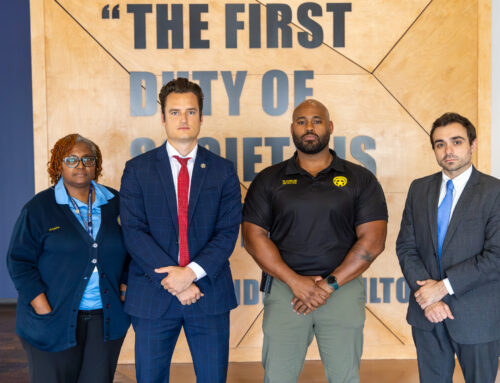
NEW ORLEANS — Wednesday, January 7, 2026, District Attorney Jason Rogers Williams held a press conference with federal, local, and community partners to highlight the sustained reductions in violent crime and to outline a 2026 public safety strategy focused on prevention, coordinated enforcement, and long-term sustainability.
“The New Orleans homicide rate is the lowest in 50 years. We’ve had three years of sustained public safety success, but this is not the time to wave a victory flag,” Williams said. “This is a time to take stock and ensure that we don’t backslide.”
Williams was joined by leaders representing a broad public safety coalition, including ATF Special Agent in Charge Joshua Jackson, U.S. Marshal Enix Smith, Deputy U.S. Marshal Brian Fair, Metropolitan Crime Commission President Rafael Goyeneche, GNO, Inc. President and CEO Michael Hecht, and OPDA leadership including Homicide Unit Chief Matthew Derbes, Strategic Initiatives Director Daniel Shanks, and Investigations Bureau Chief Aaron Washington, Assistant District Attorney Andre Gaudin, and along with community partners from Ubuntu Village.
|
Results the Public Can Verify — and a Strategy Built to Last
Williams emphasized that New Orleans’ gains are not accidental, and he pointed to multiple sources of verification.
“The results here are real and are verifiable,” Williams said. “You can look at the FBI data. You can talk to Jeff Asher. This is not a one-year anomaly, but part of a longer trajectory.”
The city’s progress reflects an aligned strategy across systems—high-quality investigations, strong prosecutions, and focused coordination with federal and community partners.
|
Accountability That Delivers — and a Playbook Built to Endure
Williams said OPDA’s specialty units—particularly the Homicide Unit, Special Victims Unit (SVU), and Sexual Assault Kit Initiative (SAKI)—have exceeded historical benchmarks in both trials and plea resolutions.
“I sat before the City Council when we were declared the murder capital of the country, and I said if they funded a homicide unit, we would not be the murder capital upon our next visit,” Williams said. “And we delivered on that promise and more.”
He added, “There simply is no finish line when it comes to public safety. Sustaining safe communities requires continuous and intentional planning. A playbook that we can all draw from, regardless of whatever happens in municipal elections.”
Homicide Unit Chief Matthew Derbes underscored that the work driving reductions spans far beyond courtroom wins.
“If we were to have a press conference and bring everybody involved who is responsible for the success we’ve had,” Derbes said, “we would probably be in the Superdome—because there are so many people working hard every single day.”
Derbes pointed to the office’s vertical prosecution model and weekly case collaboration with NOPD homicide detectives as a key factor in building the strongest cases possible.
|
Williams also recognized the role of the Metropolitan Crime Commission in keeping systems transparent and accountable.
“Criticism can be a good thing,” Williams said. “Iron sharpens iron. Disagreement, when it is honest and informed, is not a detriment. It is part of the process.”
MCC President Rafael Goyeneche credited a shift away from siloed justice operations as a key driver of sustained reductions.
“What we’re seeing is that no longer are we seeing criminal justice agencies operate as silos, but as partners in all of this,” Goyeneche said. “It can’t be done by just arrests. It requires the whole system.”
|
Federal Partnership and 2026 Priorities
|
ATF Special Agent in Charge Joshua Jackson said community tips and targeted investigations have helped address the places and people driving violence—while also protecting those not involved. “We follow up and do very focused investigative work and have the most impact on violent crime in the city,” Jackson said. “And for 2026… more to come.”
Jackson highlighted Operation NOLA Safe as an initiative bringing federal, state, and local partners together to focus resources on identified violent offenders and hotspots.
U.S. Marshal Enix Smith emphasized that coordination with OPDA has translated into arrests of the city’s most violent offenders.
|
“Having a positive working relationship with D.A. Williams has resulted in arrests of some of the worst violent offenders in our city,” Smith said. “Ultimately, that makes our community safer.”
Deputy U.S. Marshal Brian Fair added: “It’s about partnerships; we’re successful only because of our partners.”
|
NODICE Program
Williams described OPDA’s NODICE initiative as a central driver of sustained reductions, uniting agencies and community partners around shared data and targeted interventions.
“NODICE brings agencies and community partners together around a shared source of truth and data,” Williams said. “This is about precision, not overreach. This effort is about solving problems, not shifting them to another block.”
Strategic Initiatives Director Daniel Shanks described NODICE as a “group lift” rooted in diagnosing why violence concentrates and applying precise solutions.
“We’ve seen amazing results when we all come together,” Shanks said, pointing to neighborhood-level reductions including almost 80% in Treme, 42% around Hardin Park, and almost 70% in other targeted areas. Director Shanks added, “What’s hard is sustaining those gains, and over the last few years we have sustained that.”
|
Public Health is Public Safety
Williams emphasized that violence is often downstream of trauma, addiction, mental illness, and economic instability—and said the city’s next phase must connect prevention, intervention, and accountability into one plan.
“The most effective public safety strategy is preventing harm before it happens,” Williams said, crediting public health leadership and community-based “credible messengers” for intervening before conflicts turn into shootings.
Ubuntu Village Director Ernest Johnson echoed that focus: “We all have one common goal to intervene and prevent crimes from happening.”
GNO, Inc. President and CEO Michael Hecht said New Orleans’ reduction in homicide is outpacing national trends and must be sustained through continued collaboration.
“Our reduction has been about three times the national average,” Hecht said. “This is us doing something different and doing something better.”
Hecht added that the NOLA Coalition—now hundreds of members strong—will continue supporting recruiting and retention for NOPD, focusing on firearms reduction in key areas, investing in youth opportunity, and maintaining shared responsibility.
|
|
|